


Tin Swe Thant is best known as the Burmese American mother of journalist and television host Alex Wagner. Her life story, however, extends beyond that family connection. Born in Burma, now Myanmar, she grew up during the final years of British colonial influence, later moved to the United States, attended Swarthmore College, married political strategist Carl Wagner, and raised a daughter who would become a prominent journalist.
What makes Tin Swe Thant especially interesting is the way her personal experiences became part of Alex Wagner’s understanding of identity and belonging. One of the most memorable stories involves Tin being required to use a Western school name during her childhood in Burma. Alex later explored this family history in her memoir Futureface: A Family Mystery, an Epic Quest, and the Secret to Belonging.
Because Tin Swe Thant has largely remained a private person, some details repeated online are difficult to verify. This article separates well documented facts from claims that should be treated cautiously.
Tin Swe Thant Personal Details
The following table summarizes the most consistently reported information about Tin Swe Thant.
| Detail | Information |
| Full name | Tin Swe Thant |
| Best known for | Mother of Alex Wagner |
| Birthplace | Rangoon, Burma, now Yangon, Myanmar |
| Nationality | Burmese American |
| Childhood school name | Maureen |
| Education | Swarthmore College |
| Field of study | Political science, according to several secondary sources |
| Former husband | Carl Wagner |
| Daughter | Alex Wagner |
| Grandchildren | Cy and Rafael |
| Public career | Not clearly documented |
| Current age | Not publicly confirmed |
| Current residence | Not officially confirmed |
| Public profile | Private |
Major biographical sources consistently identify Tin Swe Thant as an immigrant from Yangon, Myanmar, and Alex Wagner’s mother. Alex’s biographical record also notes that her mother became a naturalized American citizen.
Tin Swe Thant Early Life in Yangon
Tin Swe Thant was born in Rangoon, the former name of Yangon, in Burma.
Her childhood took place during an important period in Burmese history. British colonial rule was coming to an end, and the country was moving toward independence and a new national identity.
Alex Wagner later described her mother’s childhood as part of the sunset of British colonialism. In recounting her mother’s story, Alex explained that Tin attended English language schools where she was not permitted to use her Burmese name.
That detail provides more than an interesting family anecdote. It illustrates how colonial institutions could influence something as personal as a child’s name.
For Tin, the experience became part of her family history and, decades later, part of Alex’s own exploration of race, ancestry, and belonging.
Her Age and How She Looks
Tin Swe Thant’s exact date of birth has not been reliably established through major authoritative sources.
Some newer biography websites estimate her age based on information about her childhood and immigration, but those estimates should not be treated as confirmed.
The same caution applies to detailed claims about her height, weight, eye color, or other physical characteristics.
Because Tin has maintained a private life, there is not the extensive public biographical record that exists for her daughter.
A reliable profile should therefore focus on documented parts of her life rather than presenting internet estimates as established facts.
The Name Change
One of the most widely reported details about Tin Swe Thant is the story behind her childhood school name.
When she attended an English language school in Burma, she was reportedly told that she needed a Western name instead of using her Burmese name.
Her father, identified in accounts of the family story as U Thant Gyi, chose the name Maureen, inspired by actress Maureen O’Hara. Tin was therefore known as Maureen Thant Gyi in her school environment.
The name did not replace her real identity permanently.
When she later moved to the United States, she was able to attend college using her given name, Tin Swe Thant.
The episode became much more significant years later when Alex Wagner learned to understand it through the lens of race, assimilation, and colonialism.
Alex has described feeling deeply affected by the idea that her mother’s Asian identity had been treated as something that needed to be changed for institutional convenience.
Leaving Burma for a New Beginning
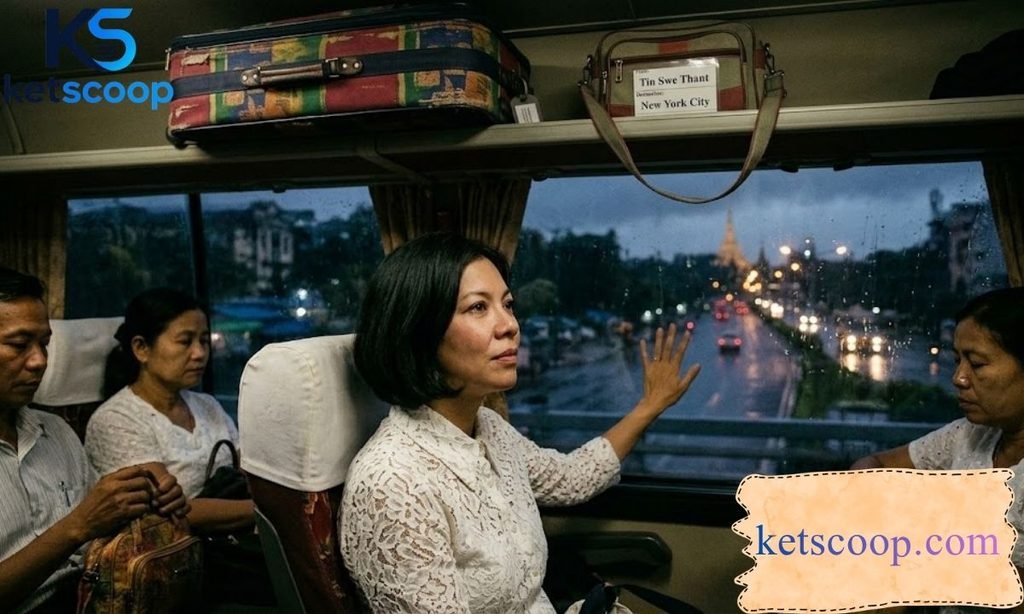
Tin Swe Thant eventually left Burma and moved to the United States during the 1960s.
The move represented a major transition. She was leaving behind her birthplace and entering a society with a different language, culture, educational system, and social environment.
Available biographical accounts consistently connect her move to the United States with her pursuit of education. She later enrolled at Swarthmore College in Pennsylvania.
Her migration story is important because it became the foundation of the multicultural family she would eventually build.
Rather than abandoning her Burmese identity, Tin carried elements of her background into her American life.
Education at Swarthmore College
Tin Swe Thant attended Swarthmore College, a respected liberal arts institution in Pennsylvania.
Several current biography pages state that she studied political science there.
Her education was an important step in establishing a new life in America. It also placed her in an environment very different from the English language schools of her childhood.
One particularly meaningful detail is that she was able to use her real name at Swarthmore rather than the Western school name she had been given in Burma.
This makes her educational journey more than a simple academic milestone. It was also part of a broader transition from colonial expectations toward greater control over her identity.
Meeting Carl Wagner and Building a Family

Tin Swe Thant eventually met Carl Wagner, an American political strategist from Iowa.
Carl became an important figure in Democratic Party politics and later co-chaired Bill Clinton’s successful 1992 presidential campaign. Alex Wagner’s biographical records identify him as the father of Alex and Tin Swe Thant as her mother.
Tin and Carl married and later welcomed their daughter, Alex Wagner, in Washington, D.C., in 1977.
Their relationship brought together two different cultural backgrounds. Tin had Burmese roots, while Carl came from an American family with German, Irish, and Luxembourgish ancestry.
The resulting family environment gave Alex a multicultural upbringing that would later become an important part of her professional and personal identity.
Tin and Carl eventually divorced. Carl died in 2017.
Who Is Carl Wagner?
Carl Wagner was a prominent Democratic political consultant and strategist.
He was particularly known for his political work and became a co-chair of Bill Clinton’s 1992 presidential campaign. His career placed the family close to major American political events.
Although Carl was professionally involved in politics, Tin Swe Thant herself remained largely outside public political life.
Their daughter inherited a combination of influences from both parents. From her father came exposure to American politics, while her mother provided a direct connection to Burmese heritage and the immigrant experience.
Her Daughter, Alex Wagner
Alex Wagner is an American journalist, author, and television host.
She was born in Washington, D.C., in 1977 and later developed a career spanning journalism, political commentary, television, and writing. Her professional work has included MSNBC, CBS, The Atlantic, and other major media organizations.
Alex’s multicultural background has been an important part of her public identity.
Her mother was an immigrant from Myanmar, while her father was an American political consultant. That combination gave Alex a personal connection to questions about race, immigration, culture, and belonging.
Alex later explored these subjects in Futureface, a memoir that investigates her family history and ancestry.
Her Bond With Alex Wagner

Tin Swe Thant’s influence on Alex Wagner appears most clearly through Alex’s writing and public discussions about family history.
The story of Tin’s childhood name change became especially meaningful to Alex as she grew older and developed a deeper understanding of racism and assimilation.
In her memoir and other discussions of her family background, Alex explored what it meant for her mother to navigate different cultural worlds.
The relationship therefore extends beyond a typical parent and child connection. Tin’s life became part of the historical and cultural framework through which Alex understood her own identity.
At the same time, details of their private relationship should not be exaggerated. Tin has remained largely outside the public eye, and much of what is known comes through Alex’s own reflections.
Read more information on : Bruce Tyson
Everyday Moments of Racism and Resilience
The name change was not the only family experience that influenced Alex’s understanding of race.
Alex has also recalled moments when people questioned whether she was adopted because she looked different from her father. One account describes an encounter at a diner where Alex felt embarrassed by the question and explained that her mother was Asian.
These experiences helped Alex recognize how quickly strangers could make assumptions about mixed race families.
For Tin, the broader lesson was one of adaptation without completely abandoning one’s identity.
Her journey from Burma to America shows how immigrants can face pressure to assimilate while still preserving language, family history, and cultural memory.
Influence on Alex’s Career
Tin Swe Thant did not become a journalist herself, but her story became relevant to the subjects Alex Wagner explored throughout her career.
Alex’s work has frequently touched on politics, culture, identity, and social issues.
Her memoir Futureface goes even further by examining ancestry and belonging.
The connection between Tin’s life and Alex’s work should not be reduced to a simple cause and effect relationship. Alex developed her own career and ideas, but her mother’s experiences provided an important personal lens through which she could understand larger questions about identity.
This is one reason Tin Swe Thant remains relevant in discussions about Alex Wagner.
Grandmotherhood and Cultural Legacy

Tin Swe Thant later became a grandmother through Alex’s family.
Alex and her husband, chef and former White House assistant chef Sam Kass, have two sons. Their children are commonly identified as Cy and Rafael.
Family accounts have highlighted the Burmese influence in their names. Alex has discussed how Tin helped choose Burmese names for her grandsons, including Mindon and Thiha, with Thiha meaning “lion.”
These details show how cultural heritage can move from one generation to the next.
Tin’s influence was therefore not limited to raising Alex. Elements of her Burmese identity continued into the next generation through family names and traditions.
Life Today
Tin Swe Thant has largely remained private in later life.
Several recent biography sites describe her as retired and living quietly in the United States, with Long Island frequently mentioned as her home.
However, details about her current residence and daily activities are not strongly established through major authoritative sources.
There have been occasional family photographs and references to Tin through Alex’s social media presence, but she has not developed a major public profile of her own.
The safest conclusion is that Tin continues to live primarily away from the media spotlight.
A Story That Reflects Many Immigrant Lives
Tin Swe Thant’s life has a significance that reaches beyond the Gumbel family style of celebrity biography.
Her journey reflects experiences shared by many immigrants:
- Leaving a familiar homeland.
- Entering a new educational and cultural system.
- Learning how to navigate language and social expectations.
- Balancing assimilation with cultural identity.
- Raising children between two cultural worlds.
- Passing heritage to a new generation.
Her childhood name story is particularly powerful because it demonstrates how large historical forces can affect ordinary personal experiences.
A school requirement may seem small, but being told that your own name cannot be used can become a lasting symbol of cultural pressure.
Life Lessons From Tin Swe Thant
Tin Swe Thant’s publicly documented story offers several broader lessons.
Education can open new paths. Her move to the United States and education at Swarthmore College became important parts of her life journey.
Identity can survive adaptation. Although she was given a Western school name, she later continued using Tin Swe Thant.
Cultural heritage can cross generations. Her Burmese background became part of Alex Wagner’s identity and was later reflected in her grandchildren’s names.
Privacy has value. Tin’s life shows that a person can have a meaningful influence without becoming a public celebrity.
FAQs
Who is Tin Swe Thant?
Tin Swe Thant is a Burmese American immigrant best known publicly as the mother of journalist and television host Alex Wagner.
Where was Tin Swe Thant born?
She was born in Rangoon, Burma, now known as Yangon, Myanmar.
What was Tin Swe Thant’s school name?
Her father reportedly chose the Western name Maureen, inspired by actress Maureen O’Hara, for her English school.
Did Tin Swe Thant attend Swarthmore College?
Yes, reliable biographical accounts identify Swarthmore College as part of her educational journey.
Who was Tin Swe Thant’s husband?
She was married to Carl Wagner, a prominent Democratic political consultant and Alex Wagner’s father.
Final Words
Tin Swe Thant’s story is ultimately about far more than being Alex Wagner’s mother.
She grew up in Burma during the final years of British colonial influence, experienced the pressure of using a Western school name, moved to the United States for education, studied at Swarthmore College, and built a family with Carl Wagner.
Her daughter, Alex Wagner, later became a prominent journalist and used her family’s history to explore questions of ancestry, race, identity, and belonging.
Perhaps the most lasting part of Tin Swe Thant’s legacy is the way her Burmese heritage continued through her daughter and grandchildren. The story of a child once required to use the name “Maureen” eventually became part of a much larger family conversation about what it means to keep one’s identity while building a life somewhere new.
Read more information on : Eila Rose Duncan

Alex Carter is a content writer and researcher focused on creating clear, engaging, and well-researched articles. He is passionate about blogging, SEO, and delivering useful information that readers can trust. His goal is to make every article simple, accurate, and valuable.
2 thoughts on “Tin Swe Thant: The Remarkable Story of Her Life Today”